
The University of the Philippines Open University’s (UPOU) Faculty of Information and Communication Studies (FICS) featured internationally renowned organizational communication scholar Dr. François Cooren of the Universitè de Montréal, widely recognized as one of the world’s foremost experts on the Communicative Constitution of Organization (CCO), at a hybrid colloquium titled, “Foundations, Ferment, and New Frontiers of CCO: Widening the Conversation,” held from July 15-17, 2026, held at the UPOU, Los Baños, Laguna, Philippines and via Zoom. The three-day event brought together scholars, faculty, researchers, alumni, and students to explore the CCO perspective.
Organized by the Decentered Human Communication (DHC) Research Group of the FICS and in partnership with the UP Office of International Linkages World Experts Lecture Series (WELS) and the UPOU Foundation Inc., the hybrid colloquium marked the DHC group’s inaugural activity, reflecting FICS’ commitment to creating opportunities for meaningful research, collaboration, and scholarly exchange.
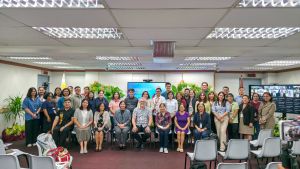
Onsite participants and organizers joined key speaker Dr. François Cooren (seated, center) for a group photo with the online participants on the Zoom screen.
UPOU Chancellor Dr. Joane V. Serrano opened the colloquium by welcoming participants, followed by an overview of the program from the chair of the Doctor of Communication (DComm) and of the Steering Committee, Dr. Jean A. Saludadez, who also served as the moderator throughout the colloquium.

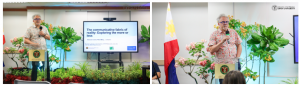
UPOU Chancellor Dr. Joane V. Serrano (left) delivered her welcome remarks, while Doctor of Communication (DComm) Program Chair Dr. Jean A. Saludadez (right) provided an overview of the colloquium.
A highlight of the colloquium was Dr. Cooren’s three-part lecture series namely, the foundations and evolving directions of CCO scholarship, the communicative fabric of reality, and the non-human agency of technology, and the concept of ventriloquism.
The colloquium also featured 12 paper presentations, five ongoing dissertations, eight dissertation and thesis proposals. Presenters explored a wide range of topics, including AI-human hybrid organizations, food governance, indigenous journalism, digital labor, crisis management, and ecological storytelling, demonstrating the breadth of contemporary communication research informed by CCO perspectives. The participants came from the Philippines, Taiwan, Japan and Finland.
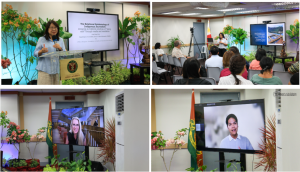
Onsite and online presentations by scholars and students of CCO.
A special session was devoted to the introduction of the International Association for Dialogue Analysis (IADA) and its publication partner Language and Dialogue by Dr. Cooren and the announcement of publication opportunities in the Management Communication Quarterly by the editor-in-chief Dr. Matthew Koschmann who joined the colloquium via Zoom.
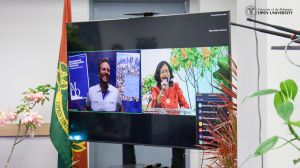
Dr. Matthew Koschmann discussed publication opportunities in Management Communication Quarterly
The colloquium concluded with closing remarks from FICS Dean Dr. Roberto B. Figueroa, Jr. who said that the conversations shared “remind us that scholarship is not only about producing knowledge but also about building a community that learns, questions and grows together”. DComm Program Chair Dr. Jean A. Saludadez also provided closing notes and encouraged participants to publish their work in the journals mentioned and continue building connections with the global research community.
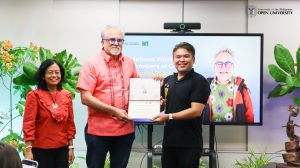
Doctor of Communication (DComm) Program Chair Dr. Jean A. Saludadez (left) and FICS Dean Dr. Roberto B. Figueroa Jr. presented a certificate of appreciation to Dr. François Cooren during the closing program.
Dr. Saludadez also mentioned that the lectures and selected presentations at the hybrid colloquium are planned to be transformed into open educational resources primarily for the use of Comm 340 (Organizational Communication) and Comm 399 (Colloquium) of the Doctor of Communication Program and of the DHC Research Group.
Written by: Loren P. Sta. Ana and Dr. Jean A. Saludadez
Edited by: Dr. Emely M. Amoloza and Asst. Prof. Shaira F. Tanay