
Mauban, Quezon, will now serve as the model municipality for a digitally empowered elderly and senior citizen-friendly community. This comes after the University of the Philippines Open University (UPOU) Faculty of Information and Communication Studies (FICS) launched “Age-Friendly Mauban,” in partnership with the Municipal Government of Mauban, Mauban eLearningVille, and Quezon Power (Philippines), Limited Co. – San Buenaventura Power Ltd., Co. (QPL-SBPL), on 15 October 2026 at the Mauban Municipal Hall.
The initiative is the first in the series to be launched under the “Age-Friendly Community” program aimed toward promoting digital inclusion among the elderly with the help of the Philippine Community eCenter Network (PhilCeCNet).
More than 30 barangay senior citizen leaders attended the event, which was led and hosted by FICS Prof. Melinda dP. Bandalaria, holder of the UNESCO Chair on Open Education and Lifelong Learning and technical adviser of PhilCeCNet, and Conchita Marta Mirabueno, center manager of the Mauban eLearningVille and Region 4A and 4B cluster representative of PhilCeCNet.
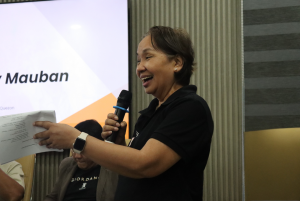
Prof. Bandalaria introduces the goals of the “Age-Friendly Mauban” to the participants.
In her opening message, UPOU Chancellor Joane Serrano encouraged the elderly to engage in lifelong learning and co-creation with community members.
“While there are new knowledge and technology that can be shared with you, I hope that you will also have the chance to pass on the knowledge to the next generation. Being a senior citizen does not mean that your role in the community becomes smaller,” Serrano told the participants.
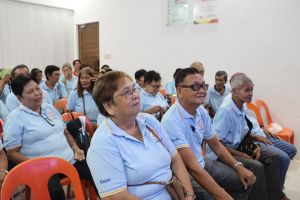
Senior citizen leaders from the various barangays of Mauban attend the program launch.
Serrano also highlighted the goal of the UPOU’s Open and Distance eLearning (ODeL) for the Third Agers Program of which “Age-Friendly Mauban” is a part.
“We hope for Mauban to become an age-friendly community, where growing older does not mean being left behind, but continuing to be included, heard, and valued,” the Chancellor ended.
Meanwhile, FICS Dean Dr. Roberto B. Figueroa Jr. discussed fostering digital inclusion as a way to give back to the elderly for all their hard work and contributions to the community.
“Digital inclusion is not simply about teaching people how to use technology. It’s also about patience, empathy, dignity, and making sure that no one is left behind,” Figueroa said. “Now, perhaps, it’s our turn to teach them a few things about technology, with the same patience, the same love, the same understanding that they have shown us throughout our lives.”
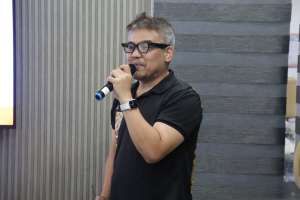
Dean Figueroa thanks the senior citizens and officials of Mauban for their involvement with the program.
Representatives from the Municipal Government of Mauban also expressed their support for the activity, including Executive Assistant Andrea Klein Lechuga on behalf of Mayor Erwin Dwight Pastrana, Vice Mayor Alween Sardea, Councilor Jenzo Pastrana, Councilor Gaddie Astoveza, Jocelyn Rodil of the Municipal Social Welfare and Development Office, and Marissa Myrna Herrera, president of the Office of the Senior Citizens Affairs. They were also joined by Chuckie Rivera, community relations manager of QPL-SBPL.
The launch of “Age-Friendly Mauban” was followed by the “Training Session on Digital Literacy for the Elderly (Techie 3rdAgers)” facilitated by Dr. Emely M. Amoloza, assistant professor of FICS and treasurer of PhilCeCNet. The session featured the module “Being Digital: Embracing Technology in Your Golden Years,” which introduced practical uses of digital technology in the everyday lives of the elderly.
Through guided discussions, visual presentations, and interactive activities, Amoloza introduced the participants to common digital applications and their uses in communication, online transactions, navigation, information access, and other daily activities.
The session also explored basic smartphone features, ways to make devices easier to use, and how to utilize mobile phones to preserve personal memories. Particular emphasis was placed on online safety, including suspicious messages and potential scams, protecting personal information, and keeping passwords, personal identification numbers (PINs), and one-time passwords (OTPs) confidential.
Activities such as “Guess the App,” “Technology Then vs. Now,” and “Budol o Legit?” encouraged participants to share their experiences, reflect on common misconceptions about technology, and develop greater confidence in navigating the digital world.
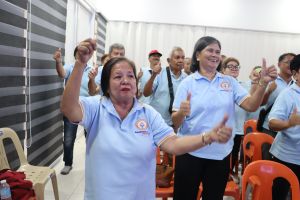
The senior citizen leaders take part in the ice-breaker activity during Dr. Amoloza’s session.
The said module is the first of five in the “Digital Literacy Training Program,” following the training curriculum adopted from the module “Senior Digizens” developed by Dr. Alexander G. Flor, professor emeritus, and Dr. Benjamina Paula G. Flor, adjunct faculty of FICS. The program aims to empower older adults to embrace technology at their own pace, use digital tools meaningfully, stay safe online, and remain connected with their families.
Other FICS faculty members also joined the event, including Dr. Jean A. Saludadez, Doctor of Communication program chair, and members of the RIPPLE Research Lab: Dr. Myra C. Almodiel, Master of Development Communication program chair, Asst. Prof. Luisa A. Gelisan, and Asst. Prof. Margaret J. Suarez.
“Age-Friendly Mauban,” together with the recently concluded “Beyond 60: A Magazine Program for the Elderly,” is part of the activities of the UNESCO Chair on Open Education and Lifelong Learning, hosted by UPOU from 2026 to 2030.
Written by: Jian Martin Tenorio
Edited by: Asst. Prof. Emely M. Amoloza and Asst. Prof. Shaira F. Tanay