
Asst. Prof. Raz S. dela Torre of the Faculty of Information and Communication Studies (FICS) presented his research on the ABS-CBN shutdown at the Philippine Media Studies Conference 2026 held at the College of Media and Communication (CMC) Auditorium, UP Diliman, on October 22.
Dela Torre’s presentation is part of the panel on “Survival and Transition in Media Disruption,” moderated by Asst. Prof. Gerard Martin Suarez of CMC, which explored upheavals in media production and preservation.
His research, titled “When the Screen Went Black: An Analytic Autoethnography of Fragmentation and Reconfiguration in the ABS-CBN Media Ecosystem (2020–2025),” examined how the COVID-19 pandemic and the denial of the renewal of ABS-CBN’s franchise changed the company’s institutional culture, partnerships, and the careers of its workers.
Dela Torre used Leon Anderson’s analytic autoethnography to draw on his professional experiences as an ABS-CBN television director, thereby examining various forms of fragmentation within the network’s media ecosystem.
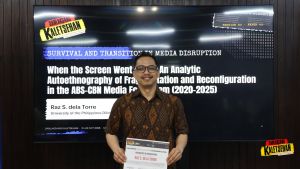
Dela Torre receives a certificate following his presentation. (Photo by Miryam Tolentino/DZUP)
The paper also used Brian Winston’s concepts of supervening social necessity and the suppression of radical potential to examine how the pandemic and shutdown accelerated changes that had suddenly become necessary for the network’s continued operation.
Through the perspective of a media professional who transitioned to the academe, dela Torre’s study sought to put a human face on a very crucial juncture of Philippine media history.
Themed “Sanlaksang Kaletsehan: Media and Communication Studies in the Time of Upheavals,” the inaugural conference is part of the 60th anniversary celebration of the UP Department of Broadcast Communication.
Dela Torre’s study reflects the commitment of FICS’ faculty members to advancing socially relevant research in media, communication, and beyond.
Written by: Jian Martin Tenorio