
University of the Philippines Open University (UPOU) Chancellor Joane V. Serrano and Faculty of Information and Communication Studies (FICS) Dean Roberto B. Figueroa Jr. joined the International Academic Conference (IAC) on Energy Justice and Energy Transition 2026 at the Museum of Metallurgy in Chorzów, Poland, with a paper presentation titled “Immersive Science Communication and the Renewable Energy Transition: A Collaborative Approach from the Global South,” on 23 October.
Part of the panel session titled “The Future of Energy: Shaping the Global Energy Landscape,” the presentation discussed how perspectives on sustainability communication and immersive open pedagogies from the Global South can make energy transition easier to understand for stakeholders.
Specifically, it showcased how UPOU’s current immersive technology projects, through science communication, translate energy-related sustainability projects into visible, digestible content.
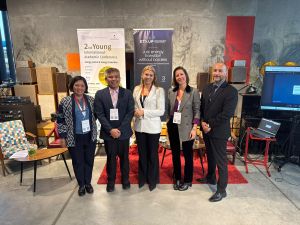
Chancellor Serrano (leftmost), Dean Figueroa (second from left), Anna Butenko, Ph.D. (second from right), and A/Prof. Alex Godoy-Faúndez (rightmost) attend the panel session moderated by Aleksandra Knap (center).
The presentation highlighted four developing projects of UPOU, including the Perma G.A.R.D.E.N. (Growing Appreciation Towards Resilience, Development, Entrepreneurship, and Nutrition), which aims to demonstrate a living model of environmental health and sustainable systems by highlighting the coexistence of human and natural systems and its potential for the sustainable management of energy.
The Perma G.A.R.D.E.N. is associated with the Sustainability in Action – A Living Laboratory Campus (SiALLC) initiative of the Faculty of Management and Development Studies (FMDS), which seeks to accelerate the sustainability efforts of the University.
Figueroa also introduced innovations from the Immersive Science Communication Open Laboratory (ISCOLab) of FICS, including “SolAR,” a virtual reality and web-compatible application set in UPOU’s Academic Residences building for solar energy simulation.
The app models the solar energy collection and consumption cycle by allowing users to manipulate the environment’s weather conditions and time of day, demonstrating the varying results of energy collection and how much energy is consumed over time.
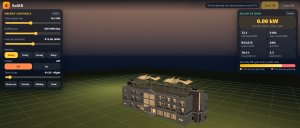
The “SolAR” app aims to make the numbers involved in solar energy collection and consumption digestible to users.
Developed by Bachelor of Arts and Multimedia Studies (BAMS) student Antoni Ernest Paul Mercado, “SolAR” illustrates the value of solar energy in sustainable energy conservation by using accurate electricity generation and consumption rates to mimic real-life scenarios of solar energy usage.
Aside from “SolAR,” Figueroa also presented “Seizora,” whose name is derived from the Japanese words seiza, meaning “proper sitting,” and sora, meaning “sky.” The app is an open-source 3D world metaverse that adopts a renewable-energy framework for an open-access virtual environment where users can learn about sustainable energy transitions in a shared learning space.
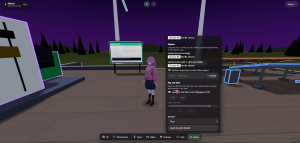
Seizora is an open-access 3D virtual learning app where users explore renewable energy in a shared world.
Developed by UPOU tutor and UP Cebu Lecturer Ziedell Alexander Figueroa, the application models a solar, wind, and battery microgrid, with its classroom acting as the main control room to manipulate the environmental conditions. It also features a lab bench, where one can design a perovskite solar cell, an affordable type of solar panel, and compare its efficiency, cost, and yield.
On the other hand, “EcoGrid: Clean Energy Transition,” developed by ISCOLab Project Technical Assistant John Alain Orbe, promotes a resilient energy future through sustainable climate financing with its 3D strategy-based game experience.
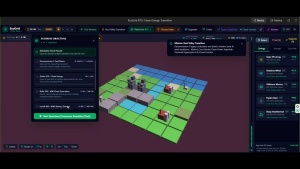
Developed by John Alain Orbe, EcoGrid is a strategy game about building a clean and resilient energy future.
Players manage a regional power grid and transform it from fossil fuel dependence to a reliable, affordable, and clean energy system. They must also balance the supply and demand of renewable energy sources while considering external factors affecting its feasibility, such as weather changes, climate emergencies, and financial constraints.
The IAC on Energy Justice and Energy Transition is an annual conference where researchers and professionals participate in exchanging ideas about the future of energy use, fostering dialogue on energy justice and energy transition. Serrano and Figueroa’s participation reflects UPOU’s commitment to forwarding sustainable initiatives for social change, especially through accessible education.
Written by: Maria Andrea Bodaño, Jian Martin Tenorio, and Christine Faye Pesimo
Edited by: Dr. Roberto B. Figueroa Jr. and Anna Canas-Llamas